

Every year, thousands of students appear in the Board of Intermediate and Secondary Education (BISE) Bahawalpur examinations, but only a selective group of toppers manage to breach the prestigious 90% threshold. Most candidates mistakenly believe that position holders possess extraordinary intelligence, whereas the reality is entirely different.
Topping the board exams is not about mindless cramming (Ratta); it is the direct outcome of a Smart Strategy, Efficient Time Management, and Flawless Paper Presentation. If you are aiming for stellar grades in your upcoming 2026 Matric or Intermediate sessions, this definitive step-by-step blueprint is crafted just for you.
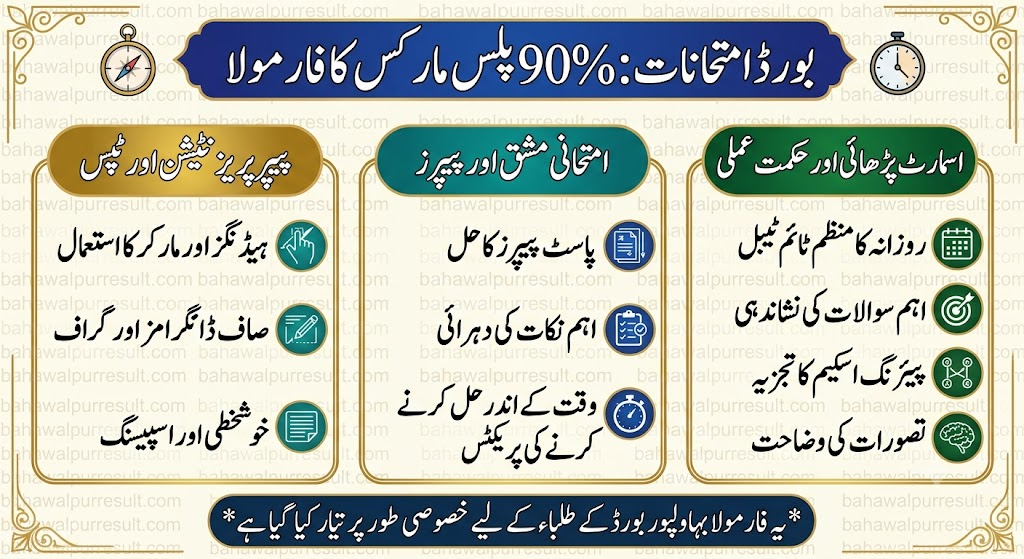
1. Deconstruct the Paper Pattern & Pairing Scheme
Studying without a targeted roadmap is simply a waste of precious time. Before diving into your textbooks, it is mandatory to analyze the official Punjab Boards Pairing Scheme.
- Say No to Blind Selective Study, Say Yes to Smart Planning: The pairing scheme clearly highlights exactly how many Multiple Choice Questions (MCQs), Short Questions, and Long Questions will be extracted from each specific chapter.
- Capitalize on High-Yield Subjects: Science subjects and Mathematics have a strictly objective marking nature where examiners cannot deduct marks for subjective bias. Ensure your grip on these scoring pillars is flawless.
2. Engineer a Realistic & High-Yield Study Timetable
Toppers do not rely on last-night cramming. Instead, they divide their heavy academic syllabus into manageable, bite-sized daily goals.
A Science-Backed Daily Routine for Board Aspirants:
| Time Slot | Activity / Subject Focus | Primary Objective |
| 05:00 AM – 07:00 AM | Mathematics / Core Science Formulas | Grasping complex numericals and critical derivations with a fresh, active mind. |
| 04:00 PM – 06:00 PM | Theoretical Sciences (Physics/Chemistry/Biology) | Comprehensive coverage of long answers, definitions, and building self-written notes. |
| 08:00 PM – 09:30 PM | Compulsory Languages (Urdu / English / Islamiyat) | Giving balanced attention to language subjects (which are often overlooked). |
| 09:30 PM – 10:00 PM | Daily Active Recall & Revision | Reviewing everything studied during the day to transfer it to long-term memory. |
Also Read About: 10th Class Marks Calculator 2026 Bahawalpur Board
3. Conceptual Clarity vs. Blind Rote Memorization
The modern evaluation trend of the Punjab Textbook Board is progressively shifting toward Application-Based and conceptual testing.
- Understand the Logic Behind Equations: Instead of blindly memorizing numerical solutions in Physics or reaction mechanisms in Chemistry, focus entirely on the underlying laws.
- The Self-Writing Litmus Test: Once you complete a topic, close the book and try to explain it on paper in your own words. If you can write it down clearly without looking, your conceptual foundation is secure.
4. Unlocking the Power of 5-Year Past Papers
In the Bahawalpur Board framework, roughly 40% to 50% of the exam questions consist of highly repeated concepts from previous academic years.
- Timed Simulation: Purchase authentic past paper booklets and simulate real exam conditions at home by setting a strict 3-hour timer. This trains your brain to manage high-pressure exam environments effortlessly.
- Decode the Examiner’s Language: Solving past papers helps you understand how a single concept can be rephrased or rotated into various confusing questions by the paper-setter.
5. Master Paper Presentation (Examiner Psychology)
Board examiners check hundreds of answer scripts every single day. A visually clean, well-structured, and aesthetically pleasing paper acts as an instant psychological trigger for bonus marks.
- The Marker Strategy: Utilize a 605 cut marker exclusively for major headings (e.g., Question Numbers, Section Titles) and a 604 marker for sub-headings or highlighting key terms.
- Structural Spacing: Always leave two clear lines or draw a neat pencil line at the end of every answer. Never crowd your text.
- The Power of Diagrams: In Biology, Physics, and Chemistry, never skip a diagram. A sharp, neatly labeled pencil diagram communicates absolute mastery to the examiner much faster than a page full of dense paragraphs.
6. Never Neglect Your Compulsory Language Papers
A classic mistake made by pre-medical and pre-engineering students is scoring full marks in core sciences while dropping to the 70s in Urdu, English, and Islamiyat/Pak Studies. This instantly drags down your overall percentage.
- English Grammar & Essays: Focus heavily on tenses, correction of verbs, and punctuation. For essays, enrich your content by embedding relevant quotes, facts, and authentic references.
- Urdu Speed & Poetry Context: Urdu requires rapid writing speed as it is notoriously lengthy. While explaining poetry (Tashreeh), always complement your paragraphs with closely related verses (Ashaar) to showcase deep literary depth.
7. The Final 30-Day Pre-Exam Crash Strategy
When the exam countdown enters its final month, halt the intake of new, unstudied topics. Dedicate 100% of your energy to two things: Rigorous Revision and Mock Tests.
- Weeks 1 & 2: Aggressively revise your self-made notes, flashcards, and textbook summaries. Plug any remaining conceptual loopholes.
- Weeks 3 & 4: Solve complete full-book model papers under strict supervision. Identify your writing speed bottlenecks and eliminate repeating mistakes.
Also Read More About: How to Prepare for Board Exams in 30 Days
Frequently Asked Questions (FAQs)
Q1: Can an average student honestly touch the 90% mark in the Bahawalpur Board?
Ans: Absolutely! High scores are the result of structured preparation, not magic. By strictly aligning your studies with the board pairing scheme and perfecting your paper presentation, any dedicated student can cross the 90% threshold.
Q2: Is it legally allowed to use black markers or pens in BISE exams?
Ans: According to official board regulations, blue ink pens and blue markers are the standard requirements. While some examiners tolerate black markers strictly for minor headings, it is highly recommended to stick entirely to shades of blue to prevent any technical compliance issues.
Q3: How do I avoid running out of time during long subjective papers?
Ans: The only solution is physical writing practice. Prioritize answering the questions you know with 100% certainty first. Allocate a maximum of 35-40 minutes for long questions, and always leave the final 10 minutes of the exam for proofreading and re-checking your MCQs.
Conclusion
Securing a 90%+ aggregate in the Bahawalpur Board is a highly systematic process. It demands a flawless blend of target-oriented planning, crystal-clear concepts, structural revision, and clean execution on the answer sheet. Start optimizing your study habits early, maintain rigorous consistency, and approach your exam hall with absolute confidence. Your name on the topper’s list is entirely within your control!
